
Group exhibition
SOOOOOO CUTE!!!!!!!!!!!!
06.03.2026 - 11.04.2026
SOOOOOO CUTE!!!!!!!!!!!!
06.03.2026 - 11.04.2026
ASNI’s two-year anniversary exhibition explores the power and origins of cuteness, as well as its blend of attraction, aggression, and repulsion. The roots of the aesthetics of cuteness in Japan can already be found in prints and painting of the Edo period (1603–1868). From the 1970s onwards, Japan experienced a boom of kawaii culture, which developed under the influence of manga and anime. Kawaii is most often translated as “cute” or “adorable,” yet the term has evolved from a purely aesthetic descriptor into a broad cultural phenomenon encompassing a complex cocktail of connotations and functioning as an instrument of “soft power.”
In her book Pink Globalization: Hello Kitty’s Trek across the Pacific (2013), anthropologist Christine R. Yano emphasizes that today cuteness is multifaceted, global, and pervasive. Living in conditions of constant stimulation, consumer culture, and performativity shaped by social media, the aesthetics of cuteness are omnipresent: in entertainment, fashion, the gaming industry, advertising, and product design, forming part of the so-called “cute-cool” culture.
Similarly, British philosopher Simon May, in his book The Power of Cute (2019), notes that cuteness is often perceived as something small, harmless, and helpless. Yet cuteness is far more ambivalent: it entices by transforming and distorting these qualities, creating a playfully indeterminate mixture of power, gender, age, morality, and even species. Cuteness functions as a kind of addictive antidote to the pressures of contemporary hyper-capitalized everyday life to always be purposeful, predictable, authentic, and in control.
American cultural theorist and feminist scholar Sianne Ngai, in Our Aesthetic Categories: Zany, Cute, Interesting (2012), describes cuteness as an aesthetic that reveals our contradictory feelings toward subordinate and non-threatening objects: a mixture of positive and negative affect, where the aesthetic category of the cute is also mediated through gender, sexuality, and social class. In this context, cuteness is no longer merely superficial charm; it can function as a strategy of adaptation, a survival mechanism, or even a subtle form of critique. At the same time, cuteness is rarely innocent: tenderness often intertwines with latent aggression. The question remains open whether it is connected with care or rather with power over that which appears small, harmless, and weak. By aestheticizing vulnerability, softness, and childishness, cuteness may incorporate discomfort, control, or even violence, masking them with affection. It is precisely this ambivalence that allows cuteness to render desire and sexuality playful, safe, and seemingly non-threatening.
By employing imagery of “niceness” and “cuteness,” the artists engage with otherness and monstrosity, expanding the boundaries of the uncanny and hybridizing the human with the non-human. And poses the question: is this aesthetic merely a symptom of late capitalism, or does it conceal deeper pleasures and new possibilities?
Curator: Elīna Drāke




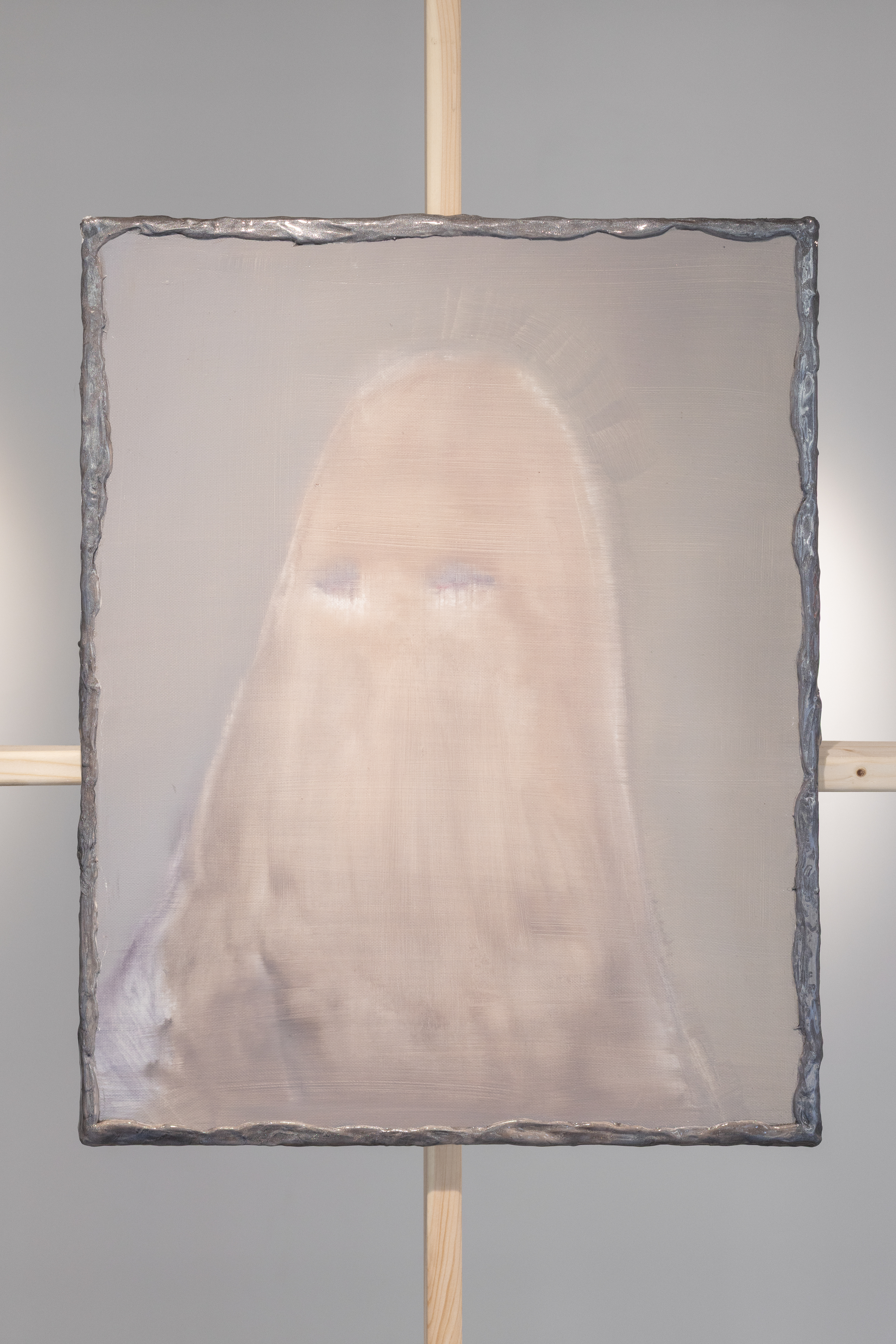
Undisclosed, oil on canvas/acrylic resin/epoxy resin, 50x40cm